Writing · family business
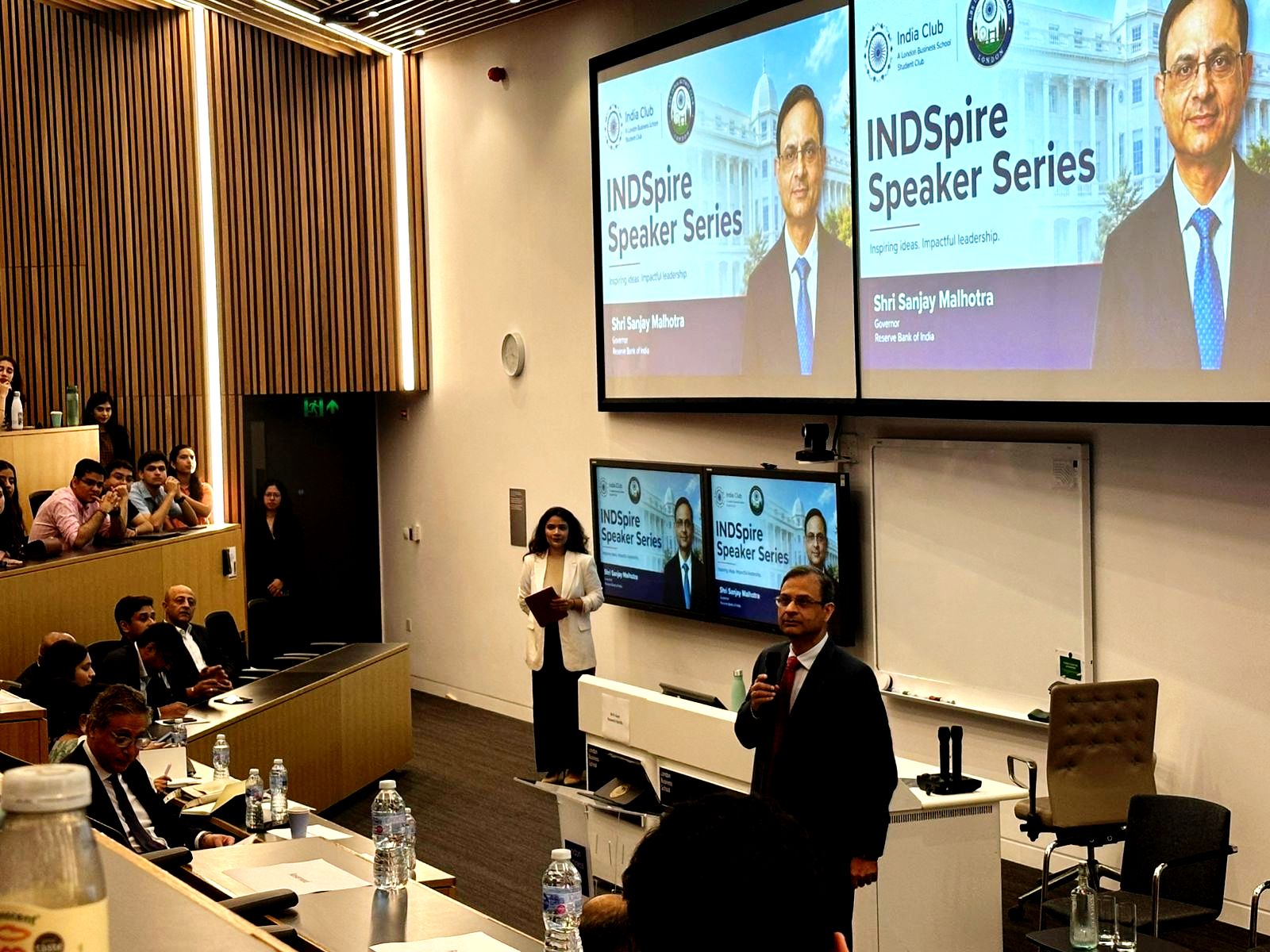
When the RBI Governor Came to London
Reflections from Sanjay Malhotra's London Business School talk, and what India's macro confidence means for promoters and family businesses.
When the RBI Governor Came to London
There are rooms that tell you something before anyone speaks.
The RBI Governor's talk at London Business School was on a UK bank holiday. The room filled anyway. Mostly Indian faces: promoters, professionals, diaspora investors, second-generation inheritors.
That room was the story.
It was not a passive audience waiting for a lecture on macroeconomics. It was a room of people trying to read India with commercial urgency. They were listening for what policy might mean for borrowing costs, currency risk, governance expectations, succession decisions, and the next round of capital allocation.
What He Said
Sanjay Malhotra, Governor of the Reserve Bank of India, opened with the fundamentals: price stability and financial stability. Under India's Flexible Inflation Targeting framework, adopted in 2016, the RBI has kept inflation down by roughly 2 percentage points. Public debt as a percentage of GDP is falling in India while it rises almost everywhere else. Governance has improved. Trust is being rebuilt through policy and institutional reform.
His central thesis was simple: India is in its best business environment in decades.
The Iran conflict, he said, will shave approximately 1 percentage point off growth this year, with crude oil and fertiliser imports being the pressure point. He called it short-term. Long-term, he expects India to return to 7.5% growth.
Then someone asked about the rupee.
The room laughed. Not cynically, exactly. More the knowing laugh of people who have heard "short-term pressure, strong fundamentals" before. The Governor held his line. He was not wrong to. India's fundamentals are, by most measures, genuinely strong. But the laugh said something the data does not: trust, once eroded, takes longer to rebuild than a policy cycle.
That distinction matters. Institutions can improve faster than memories. A promoter who lived through currency shocks, delayed payments, liquidity squeezes, or sudden rule changes does not instantly become relaxed because the latest chart looks better. The chart matters. So does the scar tissue.
What It Means for Indian Family Businesses
The Governor spoke in macroeconomic terms. But the questions family businesses face are micro - and the gap between the two is where most decisions go wrong.
Here is what I took away that is directly relevant to promoters and second-generation leaders running businesses in India today.
1. The cost of capital is about to get easier, but only for businesses that are credible.
The RBI's trust-building agenda - better governance, stronger institutions, improving transparency - rewards businesses that have professionalised. If your business runs on informal systems, verbal commitments, and founder discretion, you will not benefit from the improved environment in the same way a well-governed business will.
Banks, investors, and strategic partners read the same signals the Governor is trying to send. They also read your audit quality, receivables discipline, board composition, MIS cadence, succession clarity, and the extent to which the business can explain itself without the founder in the room.
The businesses that respond first will access capital on better terms. Those that treat governance as paperwork will pay for that informality, either through higher cost of capital or lower optionality when opportunity arrives.
2. The 1% growth drag from geopolitical disruption is a stress test you should run on your own business.
If your margins depend on imported inputs - crude derivatives, fertiliser, raw materials, freight-sensitive components - what does a 15% to 20% input cost increase do to your business?
Most family businesses I work with have never modelled this formally. They know the risk instinctively. They discuss it at the dining table, in the car, or during a tense Monday review. But it rarely becomes a structured stress test.
That is a missed opportunity. The question is not only whether your business can absorb the shock. It is whether you know in advance what you will do if the shock arrives. Which customers can take price increases? Which SKUs become unviable? Which working-capital lines need to be renegotiated before everyone else rushes to the bank?
The answer is usually uncomfortable. That discomfort is useful information.
3. "Strong fundamentals" is not a strategy.
The Governor was right that India's long-term trajectory is strong. But long-term trajectories do not pay salaries or service debt in the short term.
The businesses that will compound through this period are the ones building operating systems robust enough to absorb volatility - in input costs, in currency, in credit availability - without requiring the promoter to personally intervene every time something moves.
That is not about size. I have seen Rs 50 Cr businesses with more resilient operating systems than Rs 500 Cr ones. The variable is not revenue. It is whether execution depends on the founder's presence or on the systems the founder has built.
In practical terms, that means sharper weekly reviews, cleaner ownership, faster reporting, a real annual operating plan, a working-capital dashboard, and leadership teams that can make decisions inside agreed boundaries. It also means the second generation cannot remain ornamental. Stewardship requires operating discipline, not just shareholding.
The Room, Revisited
A UK bank holiday. A packed room at LBS. Mostly Indian faces.
The Indian diaspora in London is not just a cultural community. It is a capital network - promoters, investors, advisors, next-generation heirs - with influence over how Indian businesses are governed, funded, and grown. That room represented billions in assets and decades of operating experience.
What it also represented was a collective hunger for clarity. The RBI Governor gave them macroeconomic reassurance. What many of them actually need is a clear-eyed look at whether their own businesses are positioned to benefit from the India story - or whether they are hoping the tide will lift a boat that needs structural repair.
That is a different conversation. And it is one worth having.
If you run or advise an Indian family business and want to think through what the current environment means for your specific situation, a free 30-minute call is at jaideep.xyz.
Related Advisory Work
Turning strategy into weekly execution
If your business still depends too heavily on the founder, explore the growth operating system and the TEPL Nagpur 3x growth case study.
What to read next
Suggested Readings
Gratitude Post: My First Flight & SAP Labs Freshers’ Day
A reflection on my first-ever flight, SAP Labs India's visionary onboarding, and the mentors who shaped my early career.

Stories, Hope, and the Power of Words: An Evening with Margaret Atwood and Elif Shafak
An evening with two of the world's most celebrated literary voices exploring storytelling, hope, human connection, and the transformative power of fiction.

Running High: Ladakh Marathon & Lessons from the Mountains
Reflections on running the Ladakh Marathon, the beauty of Leh, Nubra, Pangong, and the wisdom of stillness.